The
topic of this final blog essay will be the visual influence of consumerism
culture in Japan, with special attention shown to Vending machines. When I think
of japan, in the planets since, I can’t help but recall images of places like
Akihabara, or other booming entertainment districts.
 The anime fanatic in me
remembers the gigantic gundam images and manga shops in the background. But the
scholar in me views the whole image as a statement. The action, fantastical chaos,
and billion watts powering everything served to remind me of the messages conveyed:
watch this new anime, come into this store, buy this, see these girls as maids
and buy more stuff etc. the rampant consumerism of japan is something that can
arguably be seen in every culture. However, as one classmate’s observed, “They
don’t waste any space, event he sides of the buildings have ads on them,” that
sets it apart for me. As I am merely a college junior in America, my views and
opinions may be obscure or off base but, here are my findings after having
digested many visual sources as well as articles and personal appoints of the subject.
The anime fanatic in me
remembers the gigantic gundam images and manga shops in the background. But the
scholar in me views the whole image as a statement. The action, fantastical chaos,
and billion watts powering everything served to remind me of the messages conveyed:
watch this new anime, come into this store, buy this, see these girls as maids
and buy more stuff etc. the rampant consumerism of japan is something that can
arguably be seen in every culture. However, as one classmate’s observed, “They
don’t waste any space, event he sides of the buildings have ads on them,” that
sets it apart for me. As I am merely a college junior in America, my views and
opinions may be obscure or off base but, here are my findings after having
digested many visual sources as well as articles and personal appoints of the subject.

Vending machines
When
considering aspects of Japanese visual culture, it was hard to choose what exactly
would be a good topic for my final. With all of the aspects of visual culture
discussed in class, It was made even more difficult. Therefore, I went back through
my blog as well as the courses to examine older subject matter, which I might had
forgotten about, or hadn't paid due attention to. And so I found it, one of the
most bizarrely immaculate images I first observed when entering this course,
the Hello Kitty vending machine.  Apart from the idea of “Mizenko sensei
probably has one in his basement,” the idea of was just mind-boggling. Living in
America, outside of going to cons or theme parks, the most intricate vending
machines I see on a daily bases is the “Red Box” rental unit. And so, I wanted use
this as an opportunity to to find out the reason for such a difference between cultures,
as well as enthuse over the unique innovation of some of the most amazing
vending machines I've seen.
Apart from the idea of “Mizenko sensei
probably has one in his basement,” the idea of was just mind-boggling. Living in
America, outside of going to cons or theme parks, the most intricate vending
machines I see on a daily bases is the “Red Box” rental unit. And so, I wanted use
this as an opportunity to to find out the reason for such a difference between cultures,
as well as enthuse over the unique innovation of some of the most amazing
vending machines I've seen.
Apart from the idea of “Mizenko sensei
probably has one in his basement,” the idea of was just mind-boggling. Living in
America, outside of going to cons or theme parks, the most intricate vending
machines I see on a daily bases is the “Red Box” rental unit. And so, I wanted use
this as an opportunity to to find out the reason for such a difference between cultures,
as well as enthuse over the unique innovation of some of the most amazing
vending machines I've seen.So to begin, the vending machine (自動販売機- Jidō hanbaiki) is abundant in japan, as there are about 5.52 million the highest ratio of vending machines to landmass among any other country. However, the earliest vending Machin is thought to be originated in Alexandria, Egypt 215 B.C.
 the
basic design implies a coin operated holy water delivery system. For Japan, the
first cigarette vending gadget was introduced in 1880, by the painter and
inventor, Tawaraya Koshichi placed in (now Shimonoseki, Yamaguchi Prefecture).
Years earlier, Koshichi also invented Japan’s first vending machine. It was
called, “an automatic stamp and postcard dispenser,” a wooden machine which
also functioned as a mailbox. it is said that it was based off of karakuri
dolls (wind up dolls), yet was advanced enough to dispense change as well as display
prices and restock notices. Needless to say, Koshichi took out a patent on this
as he did other inventions.
the
basic design implies a coin operated holy water delivery system. For Japan, the
first cigarette vending gadget was introduced in 1880, by the painter and
inventor, Tawaraya Koshichi placed in (now Shimonoseki, Yamaguchi Prefecture).
Years earlier, Koshichi also invented Japan’s first vending machine. It was
called, “an automatic stamp and postcard dispenser,” a wooden machine which
also functioned as a mailbox. it is said that it was based off of karakuri
dolls (wind up dolls), yet was advanced enough to dispense change as well as display
prices and restock notices. Needless to say, Koshichi took out a patent on this
as he did other inventions.
Later
on in 1950, Japan fully embraced vending machines with the coming of the
“Fountain-style Juice Dispenser.” This was juice dispenser, similar to the
oldest model found in Egypt. At that time, the usual rare was only 10 yin per
cup. In the years to come, as the demand rose, so did the amount of machines.
1964
|
240,000
|
1970
|
1
million
|
1973
|
Just
over 2 million
|
1984
|
About
5 million
|
Total
number in U.S as of Feb 2015- 4,640,000
 Another piece I red insinuated
that Japan’s pride through technological advancements. This kind of thinking
can especial is seen through thing like the touch-screen animation vending
machines as well as the apple vending machines. In addition to the convent and
quick access to foods, the advancements in vending technology has also allowed
for fresh foods to be available on demand
Another piece I red insinuated
that Japan’s pride through technological advancements. This kind of thinking
can especial is seen through thing like the touch-screen animation vending
machines as well as the apple vending machines. In addition to the convent and
quick access to foods, the advancements in vending technology has also allowed
for fresh foods to be available on demand

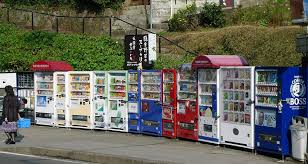 . However, the machines themselves are
a trigger. As we discussed in classes, signs are certain things present in
advertising that can convey meanings; either conscious or subconscious. In the
case of the over 5 million machines in Japan, there are over 5 million signs
and messages being transmitted into the populous. In the case of the Hello
Kitty machine, It can be broken down as two separate signs. The content of the
machine is produced by a company the company wants people to buy it. Additionally,
the machine itself is recognizably Hello Kitty. With the Kitty being such a big
idol on its own, it will attract people to the content. Vending machines even
go so far as to offer extravagant high priced prizes, as I found in one video series on youtube, a man
spent over 10000 yen on a machine trying to win a prize. Practices such as this
are perpetuated by the rampant amount of machines, as well as ads on said
machines; effectively transforming certain parts of residential places into gambling districts.
. However, the machines themselves are
a trigger. As we discussed in classes, signs are certain things present in
advertising that can convey meanings; either conscious or subconscious. In the
case of the over 5 million machines in Japan, there are over 5 million signs
and messages being transmitted into the populous. In the case of the Hello
Kitty machine, It can be broken down as two separate signs. The content of the
machine is produced by a company the company wants people to buy it. Additionally,
the machine itself is recognizably Hello Kitty. With the Kitty being such a big
idol on its own, it will attract people to the content. Vending machines even
go so far as to offer extravagant high priced prizes, as I found in one video series on youtube, a man
spent over 10000 yen on a machine trying to win a prize. Practices such as this
are perpetuated by the rampant amount of machines, as well as ads on said
machines; effectively transforming certain parts of residential places into gambling districts.
bibliography:
http://kotaku.com/why-vending-machines-are-so-popular-in-japan-1682336996
http://www.jnto.go.jp/eng/indepth/cultural/hj/vendingmachines.html
https://www.marketingsociety.com/the-library/advertising-japan-what%E2%80%99s-so-funny
http://www.infoniac.com/hi-tech/latest-invention-vending-machine-with-large-see-through-display.html
Gordon, Andrew D. 2012. Consumption, consumerism, and Japanese modernity. In The Oxford Handbook of the History of Consumption, ed. Frank Trentmann, 485-504. Oxford, UK: Oxford University Press. Accessed May 8, 2015 9:53:28 PM EDT
So, why
are vending machines so popular in Japan? As noted earlier, Japan (like other
countries) is an extremely consumeristic society. The combination of its rich
economy and current societal structure actually perfectly facilitates the
setting for so many. First off, as we have seen in this class, Japan has a
history of employing a certain esthetic; one which relies on smart design and
strategic placement to get the most out of an area, as well as accommodate the land
mass. In countries like the U>S and Germany, the annual revenue generated by
companies from vending machines scales anywhere between $64,350,000- $72,
350,000 per year in modern day. A
deciding factor in placement of these structures is placement. A lot of the
time, machines are vandalized, stolen or broken into, thus inhibiting the
maximum options of placements. Japan however, is said to have a far less severe
vandalism issue, as well as a generally lower crime rate. Therefore, it is
possible to place sneaker vending machines in the middle of a bustling city street
with significantly less concern for someone breaking into them.
The work
schedules of most salary men and students in Japan, there was a growing need
for food on the go. This was especially prevalent around the 70’s and early
2000’s. As such, companies increased production of readily accessible foods.
This meant that the myriad vending machines were flooded with new cheap, fast
food for all the busy myriad people of the cities.

bibliography:
http://kotaku.com/why-vending-machines-are-so-popular-in-japan-1682336996
http://www.jnto.go.jp/eng/indepth/cultural/hj/vendingmachines.html
https://www.marketingsociety.com/the-library/advertising-japan-what%E2%80%99s-so-funny
http://www.infoniac.com/hi-tech/latest-invention-vending-machine-with-large-see-through-display.html
Gordon, Andrew D. 2012. Consumption, consumerism, and Japanese modernity. In The Oxford Handbook of the History of Consumption, ed. Frank Trentmann, 485-504. Oxford, UK: Oxford University Press. Accessed May 8, 2015 9:53:28 PM EDT
