
second, was my concept of art. As an individual who knows nothing of the aft world and it's history beyond anime and manga, i assumed that art was simply renascence work or irritating modern stuff (no offence).
However, murokami's work absolutely blew me away.  from the forms, to the s\colors, to the hours i spent talking with friends, ultimately repeating "what the hell is superflat", everything i thought i knew about "art" was changed. His, along with Takano's showed me two things: that art can be pulled from more than classical depictions, and that what is thought to be appropriate is largely subjective ; a lot of the shock that came from viewers on things like "lonesome cowboy" were in accordance with individual societal norms.
from the forms, to the s\colors, to the hours i spent talking with friends, ultimately repeating "what the hell is superflat", everything i thought i knew about "art" was changed. His, along with Takano's showed me two things: that art can be pulled from more than classical depictions, and that what is thought to be appropriate is largely subjective ; a lot of the shock that came from viewers on things like "lonesome cowboy" were in accordance with individual societal norms.
Lastly, i found the conversation of styles to be personally challenging. At several points in my life, i had had negative experiences on the topic of race and racial presentation. as such, i had lived most of my life ignoring such things, And even negating my own ethnicity thinking "what does it matter". So, when we saw such things in class as b-girl and Ganguro 
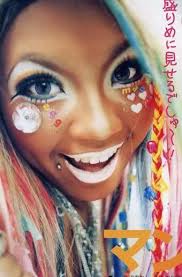 , i'm still not entirely sure how to feel. being that this is a Visual Culture studies class, i had been prying my eyes open, to look deeper into the Japanese relationship to it to question weather or not it's realistic to be offended by this sort of thing of if it is simply my personal interactions with the original context (ghetto style before b-gal). Nevertheless, for better or worse, the discussions of Japanese street fission fascinated me and was deeply thought-provoking ーありがとうございました。

Hi! I agree with the very first thing that you said. The gaze is such an important part to any visual culture. I feel like I "understand" or "connect" to what the gaze is because I am female. I'm not sure if that is right for me to say, however it's how I feel. I really liked the discussion that took place in that portion of the class... and how it continued on in all of the unit discussions.
ReplyDeleteI definitely agree with your comments concerning SuperFlat. Before taking this course I never would have given any of those pieces a second glance at an art gallery, but now I see them for what they really are: representations of opposition towards social standards. Thank you for your post.
ReplyDeleteHi Melvin. I really liked your comment on superflat. I agree, I think that this was one of the most revealing units because it not only made you question how much Western culture influences our opinions of art, but also revealed the power of imagery and meaning.
ReplyDeleteHi Melvin. I really liked your comment on superflat. I agree, I think that this was one of the most revealing units because it not only made you question how much Western culture influences our opinions of art, but also revealed the power of imagery and meaning.
ReplyDeleteHi Melvin, I really empathize with your comment on Japanese fashion. To me, when I compare a group's style of clothing in Japan to a gang, the difference lies in apparel. The Shibuya buy their clothes exclusively in Shibuya and represent that specific sector, whereas a gang might identify with a specific color or one singular attribute that could cover a lot of distance . I really found Japanese fashion exciting to learn about too.
ReplyDeleteHey Melvin, I think you touched on a lot of really interesting topics here - from orientalism to Murakami's trippy art, to ethics of mimicking other races. I like that you admitted your confusion on the latter topic, as I find it a sticky situation as well, and I'm not sure of the best answer. Anyway, it was quite thought-provoking. Thanks for your post!
ReplyDeleteHi Melvin! I have to agree with you on your opinion of fashion. I don't completely understand why the Japanese have so many different styles of odd attire. The different styles are not my cup of tea and to be honest I think they are just trying to draw attention to themselves. They would be getting lots of weird looks if they were in the US!
ReplyDelete